Current Viewing Room
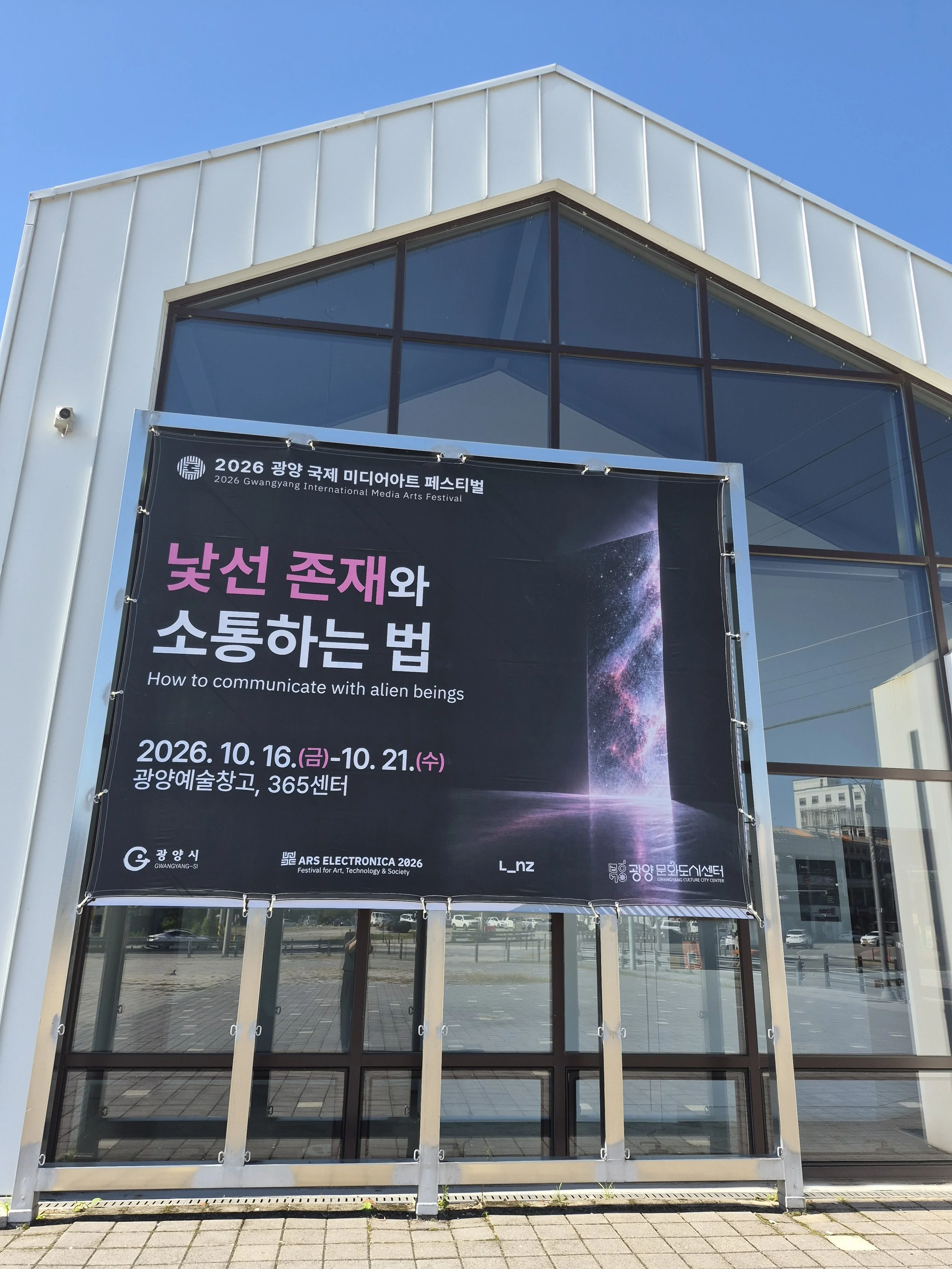
How to Communicate with Alien Beings
October 16 - 21, 2026
curated by Stephanie S. Kim
광양국제미디어예술제
2026년 10월 16~21일
대한민국 광양 365센터
한국의 예술가 소보람
오스트리아 사운드 아티스트 하이케 칼텐브루너(Heike Kaltenbrunner)
낯선 존재와 소통하는 법
방에 들어갈 때, 가장 먼저 기억해야 할 것은 듣는 것이다. 파이프가 서 있고, 튜브가 연결된 오르간이 놓인 방에 들어서면, 당신의 몸은 전자기장에 변화를 일으킨다. 이제 당신은 파동과 몸짓으로 소통할 수 있다. 접촉은 필요 없다. 오직 가까이 다가가는 것만으로 충분하다. 가까이 손을 내밀자 약하고 디스토피아적인 울림이 퍼진다. 소리는 공간을 떠난 뒤에도 귀에 메아리처럼 남는다. 당신은 방금 “전쟁의 소음”을 연주했다.
두 번째 방으로 간다. 생각해야 할 것은 리듬, 즉 운율이다. 방에는 여러 개의 북이 놓여 있다.
“미생물 행진” 이곳도 악기가 곧 작품이다. 북의 막, 다시 말해 북의 ‘피부’는 식물성 재료를 기반으로 한 미생물 배양 과정을 통해 길러졌다. 서로 다른 환경에서 배양된 열두 개의 몸이 다른 음높이와 리듬을 만든다. 각각의 몸에 새겨진 물질적 역사. 이를 읽는 것은 앎으로, 그리고 앎은 소통으로 이어진다.
두 작품 모두 소리를 매개로 한다. 하지만 왜 이러한 몸과 물질에서 소리가 발생하는지, 그리고 우리의 개입이 그 소리를 어떻게 변화시키는지를 생각하는 순간, 새로운 가능성은 확장되고 가속된다. 바로 이 지점에서 ‘낯선 존재’가 등장한다. 나는 이 단어를 도나 해러웨이의 ‘친족’에 관한 사유와 가까운 의미로 사용한다. 타자, 타자화된 존재, 그리고 우리가 아직 소통하는 법을 알지 못하는 존재들이다. 그들은 미생물일 수도, 식물일 수도, 기술적이거나 기계적인 존재일 수도 있다. 혹은 우리가 익숙하게 정의해 온 ‘인간’의 범주 밖에 있는 존재일 수도 있다.
하이케 칼텐브루너의 〈전쟁의 소음〉은 역사적 폭력의 흔적을 통해 기계적 몸이 말하게 한다. 세계대전 당시, 조화로운 선율을 만들어내던 악기의 금속은 전쟁 도구를 제작하기 위해 징발되었고, 소리 자체도 선전의 수단으로 동원되었다. 반면 소보람의 〈미생물 행진〉은 그 논리를 뒤집는다. 우리 자신의 것이 아닌 몸을 이용하는 대신, 그 몸의 소리에 귀 기울인다는 것은 무엇을 의미하는가? 두 작품은 모두 역사에 목소리를 부여한다. 동시에 인간이 아닌 존재들의 몸에 귀 기울이고, 인간 사회를 지배해 온 위계질서를 다시 생각하도록 요청한다.
“낯선 존재와 소통화는 법” 주제는 광양미디어아트 페스티벌과 아르스 일렉트로니카에 지원한 많은 작품들을 관통하는 다양한 소리에 반응한 것이었다.ㅊ즉 ‘낯선 존재’와 소통한다는 의미는 외계 생명체와의 만남을 상상하는 일이 아니다. 오히려 우리의 시선을 뒤집어, 타자의 위치에서 우리 자신을 바라보는 일이다. 그리고 이것은 역설적으로, 지극히 인간적인 질문이다.
그리고 이는 올해 아르스 일렉트로니카 테마였던 ‘인간다움에 대한 재조명’과도 연결된 질문이었다.
스테파니 김승민.
Dr. Stephanie Seungmin Kim
— — — — — — —
Gwangyang International
Media Arts Festival
October 16–21, 2026
365 Center in Gwangyang, South Korea

Boram Soh, Korean artist
Heike Kaltenbrunner, Austrian sound artist
How to Communicate with Alien Beings
The first thing to remember: Listen. And then step right into it. When you enter the small chamber of pipes and tubes, your body will alter the electromagnetic field. Now you can communicate with a wave, a gesture. No touch, only proximity. A fragile, dystopian sound emerges and becomes part of the echo you carry away. You have just played Noise of War.
Your second consideration is cadence. In the next room stands a set of drums. This is Microbial Procession. Here too, the instruments are the artwork. Their membranes, their “skins,” were grown through plant-based microbial cultivation. Twelve bodies, cultivated under different conditions, produce distinct pitches and rhythms. Each carries the material history of how a body became an instrument. To read that history is to understand, and understanding becomes the beginning of communication.
Both works use sound, yes, but sound is not the only point. It is by considering why sound is a product of these bodies and materials – and your interaction with them – that possibilities expand and accelerate. This is where the “alien” enters.
I use the word in a sense close to Donna Haraway’s thinking on kinship: the other, the othered, the beings we do not yet know how to communicate with. They may be microbial, vegetal, technological, mechanical, or simply outside our familiar definition of the human.
Noise of War by Heike Kaltenbrunner makes a mechanical body speak through traces of historical violence. In the World Wars, the metal of instruments made for harmony was requisitioned to make implements of war, and sound itself was turned into a tool of propaganda. Boram Soh’s Microbial Procession turns the logic around: it asks what it means to hear, rather than use, a body that is not ours. Both give voice to history, and both ask us to listen to nonhuman bodies and reconsider the hierarchies that shape human society.
The theme, “How to Communicate with Alien Beings,” emerged as a response to the diverse voices and sounds running through the many works supported by the Gwangyang Media Art Festival and Ars Electronica—works that sought to reverse our perspectives and invite us to listen differently.
To communicate with “alien beings” is not to imagine an encounter with extraterrestrial life. Rather, it is to reverse our perspective and look back at ourselves from the position of the Other.
Paradoxically, this is a profoundly human question. It is also a question that resonates with this year’s Ars Electronica theme: Negotiating Humanity.
Dr. Stephanie Seungmin Kim